
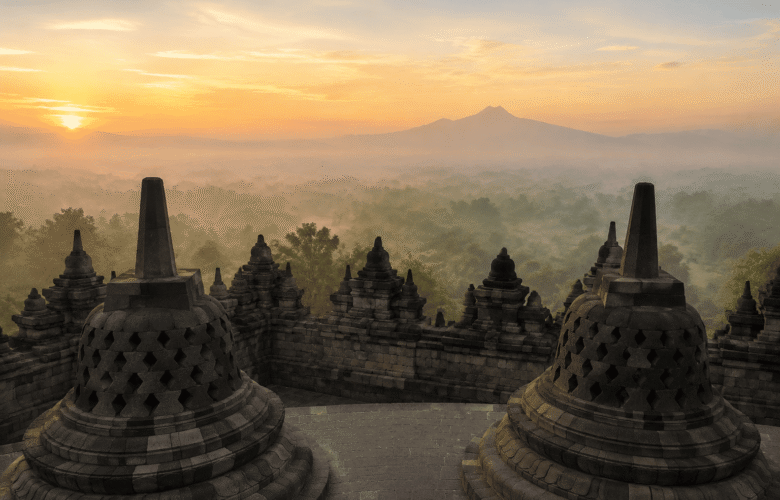
The Borobudur Temple Abandonment History describes the long journey of one of Indonesia’s most remarkable Buddhist monuments. Built during the Sailendra Dynasty between the 8th and 9th centuries, Borobudur once served as an important center of Mahayana Buddhist activities in Java.
The temple represented spiritual knowledge, artistic achievement, and royal support. However, social, political, and religious changes eventually caused Borobudur to lose its original role and become forgotten for centuries.
The Beginning of Borobudur’s Decline
Borobudur began to decline after major changes occurred in ancient Java. Around the 10th century, the center of political power moved from Central Java toward East Java.
This movement affected the importance of many monuments in the region. As new kingdoms developed, Buddhist influence gradually decreased in Java.
The rise of different religious traditions also changed the cultural landscape. Borobudur was no longer used as an active pilgrimage destination as frequently as before.
Visitors can discover more about this transformation through Borobudur Temple history, origins, rediscovery, restoration, and legacy.
Natural Factors Behind the Abandonment
The abandonment of Borobudur was not caused by a single event. Natural conditions also contributed to the temple’s disappearance from public attention.
Volcanic activity from nearby mountains affected the surrounding area. Layers of volcanic ash, soil, and tropical vegetation gradually covered parts of the monument.
The dense environment made Borobudur difficult to see. Over time, the temple became hidden beneath nature.
Although the monument was neglected, local communities still preserved knowledge about the ancient structure. Stories about Borobudur continued among people living near the site.
Rediscovery in the 19th Century
Borobudur returned to international attention during the early 19th century. Sir Thomas Stamford Raffles, who governed Java during the British period, received information about the hidden monument.
Researchers later investigated the site and documented its condition. Their studies revealed the historical importance of Borobudur as a masterpiece of Buddhist architecture.
Early restoration activities focused on removing vegetation and protecting damaged sections. These efforts helped introduce Borobudur to historians and visitors worldwide.
Restoration and Preservation Efforts
Major restoration programs were carried out during the 20th century to protect Borobudur. Indonesian government worked with international organizations to conserve the monument.
Largest restoration project took place between 1975 and 1982 with support from UNESCO. Program strengthened the structure and protected thousands of stone blocks and relief panels.
Today, conservation teams continue monitoring Borobudur. They maintain the monument while balancing tourism activities and preservation needs.
Borobudur’s Importance in Modern Times
After centuries of abandonment, Borobudur became one of Indonesia’s most valuable heritage sites. The monument now represents Buddhist history, ancient Javanese culture, and architectural innovation.
Visitors explore Borobudur to understand its spiritual meaning and historical development. The temple attracts tourists, researchers, and Buddhist pilgrims from many countries.
Travelers who want to experience this ancient monument can join a Borobudur Temple tour to explore its architecture, history, and cultural significance.
Conclusion
The Borobudur Temple Abandonment History shows a remarkable transformation from a forgotten monument into a global heritage symbol. Political changes, religious developments, and natural conditions shaped the temple’s long journey.
Understanding this history helps visitors appreciate Borobudur beyond its beauty. Every terrace, relief, and stone represents a story of creation, decline, rediscovery, and preservation.
