
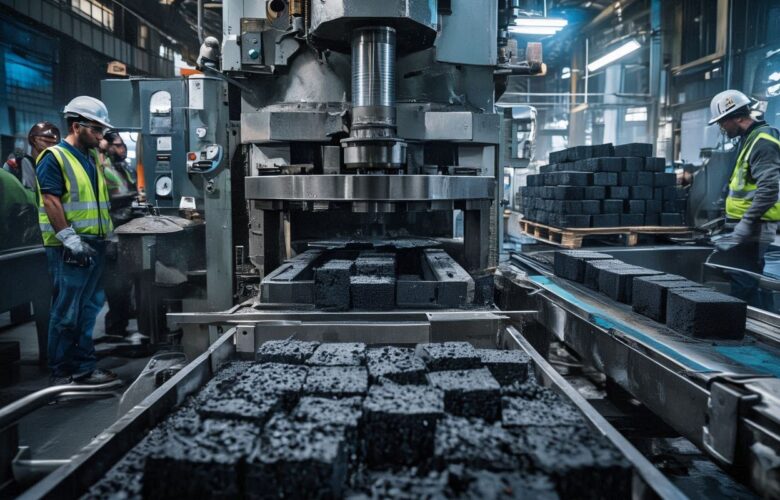
Industrial Hookah Charcoal Pressing Machine plays a crucial role in modern charcoal manufacturing because it transforms fine coconut charcoal powder into solid, uniform briquettes. This machine directly affects density, shape, durability, and overall burning performance of hookah charcoal. Without proper pressing technology, even high-quality raw materials cannot achieve consistent output.
In large-scale production, manufacturers rely on this machine to maintain speed, stability, and product uniformity. It ensures every briquette has the same structure, which is essential for export-grade hookah charcoal.
Role Of Pressing Machine In Production
The main function of an Industrial Hookah Charcoal Pressing Machine is to compress charcoal powder mixed with natural binders into solid shapes. This process removes air gaps and creates a dense structure that burns slowly and evenly.
A stable pressing system ensures consistent product quality across thousands of briquettes per hour. This consistency helps manufacturers meet strict market standards and customer expectations.
How The Pressing Process Works
The process begins when prepared charcoal powder enters the feeding system of the machine. The mixture usually contains fine coconut charcoal powder and a natural binder such as tapioca starch.
Inside the machine, high pressure compresses the material into molds. The Industrial Hookah Charcoal Pressing Machine controls pressure, timing, and mold shape to produce uniform briquettes. Once pressed, the briquettes are ejected and moved to the drying stage.
Importance Of Pressure Control
Pressure level determines the final density of the briquette. If pressure is too low, the briquette becomes fragile and burns too fast. If pressure is too high, it may crack during drying or become too difficult to ignite.
Proper pressure control ensures balanced density and stable combustion. That is why manufacturers carefully calibrate the Industrial Hookah Charcoal Pressing Machine to match raw material characteristics.
Types Of Pressing Machines
There are several types of pressing machines used in hookah charcoal production. Hydraulic machines provide high pressure and are suitable for dense briquettes. Mechanical press machines offer high speed and are ideal for large-scale production.
Each type of Industrial Hookah Charcoal Pressing Machine has advantages depending on production goals, capacity, and product specifications.
Mold Design And Shape Consistency
Mold design affects both appearance and airflow during burning. Common shapes include cube, hexagonal, and finger briquettes. Each shape influences how oxygen flows through the charcoal and how evenly it burns.
A well-designed mold ensures uniform size and weight. This consistency is important for packaging and export standards, making the Industrial Hookah Charcoal Pressing Machine a key factor in product branding.
Temperature And Material Behavior
Even though pressing is a mechanical process, temperature still plays a role. Slight warmth in the material can improve binding efficiency and reduce cracking during compression.
Maintenance And Machine Stability
Regular maintenance ensures long-term performance and stable output. Dust buildup, worn-out molds, and pressure imbalance can affect briquette quality.
Quality Issues From Poor Pressing
If pressing is not controlled properly, several problems may occur. These include uneven density, cracking during drying, inconsistent burn time, and fragile briquettes that break during packaging.
Role In Large Scale Production
In industrial settings, speed and consistency are essential. This machine allows continuous production with minimal variation between batches. It supports high output while maintaining strict quality standards.
Conclusion
Industrial Hookah Charcoal Pressing Machine is a core component in producing high-quality hookah charcoal briquettes. It controls density, shape, durability, and burning performance. When properly managed, it ensures stable production, consistent quality, and efficient large-scale output.
For manufacturers seeking stable raw materials and reliable production support, many rely on coconut charcoal briquette suplier. Additional insights into charcoal production and industry practices can be found at jacoid.com.